



PCOS Renamed to PMOS became one of the biggest developments in women’s health in 2026. The official transition to Polyendocrine Metabolic Ovarian Syndrome (PMOS) reflects a better understanding of the condition and its metabolic, hormonal, and reproductive impact. Many assumed it was simply about ovarian cysts. Some believed it only affected fertility. Others were told their symptoms were “normal hormonal changes” and sent home without answers.
Now, that has changed.
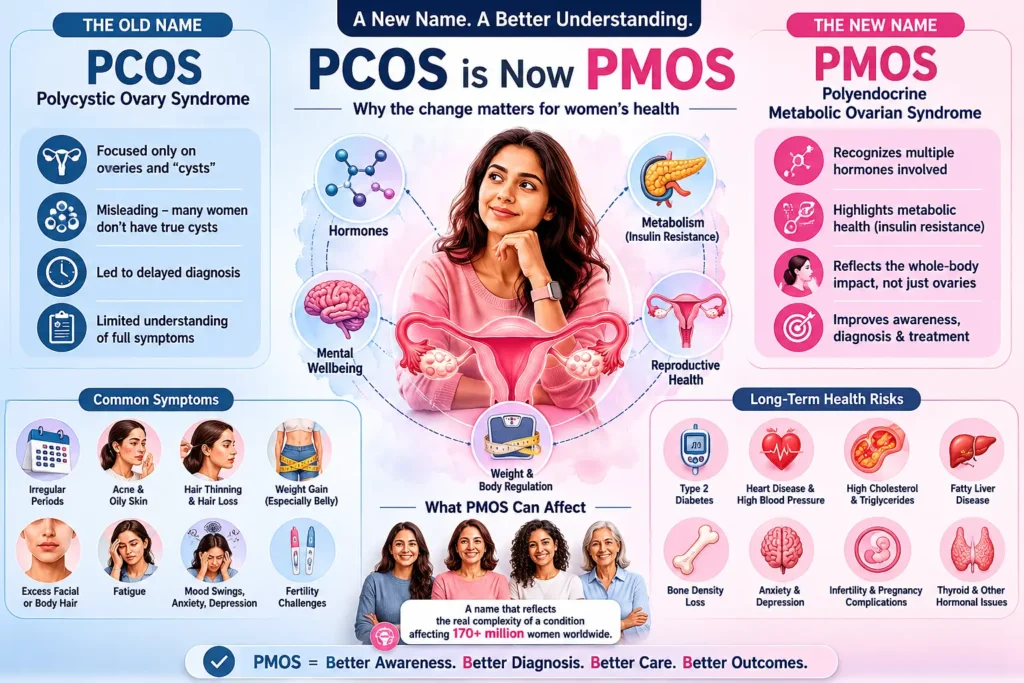
In 2026, PCOS was officially renamed Polyendocrine Metabolic Ovarian Syndrome (PMOS) after a major international collaboration involving more than 50 medical and patient organizations, reflecting a better understanding of what this condition actually is
This is more than a name update. It represents a major shift in how women’s health is understood.
The old name failed to capture the reality of this condition. Many women with PCOS do not actually have ovarian cysts in the way the name suggested. What they do experience is a complex mix of hormone imbalance, metabolic dysfunction, reproductive health challenges, skin issues, weight struggles, insulin resistance, and mental health effects.
If you’ve searched for PCOS symptoms, this article will help you understand what has changed, what hasn’t, and why this matters.
Why the Name PCOS Was Always Misleading
The term “Polycystic Ovary Syndrome” has confused patients for decades.
The biggest misconception? That ovarian cysts define the condition.
In reality, those small structures seen on ultrasound are not dangerous cysts in the traditional sense. They are immature follicles—fluid-filled sacs that failed to release eggs properly.
This meant the name focused on one visible sign instead of the full disorder.
Medical experts increasingly argued that this caused delayed diagnosis and poor awareness. Women with acne, facial hair growth, irregular periods, unexplained weight gain, or insulin resistance often didn’t realize these were connected.
That misunderstanding has had real consequences.
According to the World Health Organization, PCOS affects an estimated 8–13% of women of reproductive age globally, and up to 70% remain undiagnosed.
That’s an enormous gap for one of the most common hormonal disorders in women.
PCOS Renamed to PMOS: Why the Change Happened in 2026
The new name—Polyendocrine Metabolic Ovarian Syndrome (PMOS)—better reflects what doctors and researchers now understand. Let’s break that down.
Polyendocrine means multiple hormone systems are involved. This condition is not limited to reproductive hormones. It can affect insulin, androgens, metabolic regulation, and stress-related hormonal pathways.
Metabolic highlights one of the most overlooked aspects. Many women with PCOS struggle with insulin resistance, weight management, abnormal cholesterol, and increased long-term cardiometabolic risk. Ovarian remains because reproductive function is still affected. But the condition is no longer framed as being “just about ovaries.”
This rename came after a 14-year international effort and over 22,000 survey responses from patients and healthcare professionals
That scale alone shows how significant this issue has become.
The Most Common PCOS Symptoms Women Experience

Search interest around PCOS symptoms remains high because symptoms can look very different from one woman to another.
That variability is part of why diagnosis often takes so long. Some women first notice irregular menstrual cycles. Others struggle with acne that doesn’t improve with standard skincare. Some only discover the condition when trying to conceive.
Common symptoms include:
Irregular or missed periods. Unexpected weight gain, especially around the abdomen.
Excess facial or body hair growth due to elevated androgens. Hair thinning or scalp hair loss.Persistent acne, especially along the jawline.
Darkened skin patches, particularly around the neck or underarms. Difficulty losing weight despite diet efforts. Fatigue and energy crashes.
Mood changes, anxiety, or depressive symptoms. Fertility challenges. Not every woman experiences every symptom. Some women appear lean and still have PCOS. Others have significant metabolic symptoms.
That’s exactly why the condition needed a broader, more accurate name.
The Metabolic Side Most Women Are Never Warned About
One of the biggest reasons this rename matters is because metabolic health has often been under-discussed. PCOS isn’t only a reproductive issue.
Research suggests 50–75% of women with PCOS experience insulin resistance, depending on phenotype and body composition.
Insulin resistance happens when the body’s cells stop responding efficiently to insulin. The pancreas produces more insulin to compensate. Higher insulin levels can then stimulate excess androgen production.
That creates a cycle:
More insulin → more male hormones → disrupted ovulation → worsening symptoms.
This explains why some women feel trapped despite trying multiple diets. It’s not always about willpower. It’s biology. Women with PCOS also face increased risk of:
Type 2 diabetes Prediabetes
High blood pressure
Abnormal cholesterol
Non-alcoholic fatty liver disease
Cardiovascular complications
This metabolic dimension is exactly why PMOS is a more medically accurate term.
PCOS and Mental Health: The Hidden Burden
Hormonal conditions rarely, if ever, confine their impact to the physical body alone.
The mental health consequences are often profound, creating a psychological burden that many women find just as challenging as their physical symptoms.
Research has consistently shown that women diagnosed with PCOS are significantly more likely to navigate struggles with anxiety and depression than those without the condition.
This connection is deeply rooted in several biological and social factors.
Hormonal fluctuations directly interfere with mood regulation, while chronic insulin instability can trigger persistent fatigue and irritability.
Beyond biology, the visible signs of the disorder—such as persistent acne, facial hair growth, or scalp hair thinning—can deeply erode self-confidence.
The emotional strain is further amplified by fertility uncertainty and the weight-related stigma that many women face in both medical and social settings.
For millions, these factors converge into a complex mental health challenge that is too often overlooked in standard care.
This is precisely why integrated awareness and accurate naming are so critical.
A more medically accurate name—like PMOS—helps shift the global conversation away from oversimplified assumptions and toward a more compassionate, comprehensive understanding of women’s health.
Fertility and Reproductive Health Still Matter
While the transition to PMOS highlights a broader clinical reality, the impact on fertility and reproductive health remains a central concern for millions of women.
Persistent ovulation irregularity is one of the condition’s most defining features, creating a biological hurdle for those wishing to conceive.
When eggs are not released consistently or predictably, the journey toward conception naturally becomes more complex and uncertain.
However, it is vital to offer an important clarification:
A diagnosis of PCOS (or PMOS) does not equate to infertility. Many women experience symptoms for years without realizing they may be connected to PCOS, here’s a detailed look at why PCOS is increasing rapidly in women and what factors are contributing to its growing prevalence worldwide.
In reality, many women with this condition conceive naturally without intensive medical intervention.
For others, successful outcomes may require targeted support, such as ovulation induction, metabolic regulation, or specialized reproductive treatments.
The key to improving these outcomes lies in early, accurate diagnosis.
When symptoms are identified sooner, hormonal balance and metabolic health can be managed with greater precision and effectiveness.
By addressing the condition holistically, women can significantly improve their reproductive health and overall quality of life.
Why Diagnosis Takes So Long
For countless women, the path to understanding their health is obstructed by the frustrating reality of delayed diagnosis.
Many navigate years of revolving appointments, consulting dermatologists for persistent acne without uncovering the root cause.
Others are repeatedly dismissed with oversimplified advice to “just lose weight,” ignoring the underlying biological drivers.
Some are told that their irregular cycles are merely “normal hormonal changes,” leaving them without necessary answers or support.
This fragmented care occurs because symptoms manifest across seemingly unrelated physiological systems.
Skin health and complexion.
Hormonal balance and endocrine regulation.
Metabolic function and insulin sensitivity.
Mental health and emotional wellbeing.
Reproductive function and fertility.
Without a commitment to integrated awareness, the full clinical picture remains obscured.
The World Health Organization estimates that up to 70% of affected women remain undiagnosed—a staggering gap in modern care.
This statistic highlights why the decision for PCOS Renamed to PMOS could help improve recognition and diagnosis worldwide.
The shift to PMOS actively encourages clinicians to look far beyond the ovaries alone.
How Treatment Is Changing
While the transition to PMOS does not mean that clinical protocols will transform overnight, it signifies a profound shift in the medical landscape.
This evolution is already beginning to reshape how healthcare professionals approach patient care and intervention.
Modern management is moving toward a more nuanced, individualized strategy that addresses the condition’s multi-system impact.
Depending on a woman’s unique symptom profile, comprehensive treatment may involve:
Lifestyle interventions specifically designed to improve insulin sensitivity and metabolic health.
Balanced nutrition strategies that prioritize glucose regulation and long-term vitality.
Regular movement to support cardiovascular health and androgen balance.
Weight management support that recognizes the biological hurdles of hormonal dysfunction.
Hormonal medications to regulate menstrual cycles and manage endocrine symptoms.
Ovulation support for those navigating their fertility journey and reproductive goals.
Androgen management to address persistent acne and unwanted hair growth at the root.
Mental health care to provide essential support for the emotional and psychological burden of the condition.
Sleep improvement strategies to optimize recovery and metabolic function.
Long-term metabolic monitoring to reduce future cardiometabolic risks.
The most critical shift, however, is the broader clinical recognition that this condition demands a holistic lens.
Accurate naming is the catalyst for more transparent and compassionate clinical dialogue.
Ultimately, better conversations are the foundation for the life-changing care that millions of women deserve..
Conclusion
The transition from PCOS to PMOS marks a major turning point in women’s health.
For too long, the condition’s name minimized its true complexity.
This is not simply about reproductive health.
It is about hormones, metabolism, insulin resistance, mental wellbeing, fertility, and long-term health.
If you’ve been searching for PCOS symptoms, the most important takeaway is this:
The condition is broader than most people realize—and now the name finally reflects that.
Better language creates better awareness.
And better awareness can change lives.
FAQs
Q. Is PCOS officially renamed to PMOS?
Yes. In 2026, international medical experts, endocrine researchers, and patient advocacy organizations officially introduced PMOS (Polyendocrine Metabolic Ovarian Syndrome) as the new name for what was previously known as PCOS (Polycystic Ovary Syndrome). The change was made because the old name was medically misleading and focused too heavily on ovaries and “cysts,” even though many women with the condition do not have ovarian cysts in the traditional sense. The new term better reflects the hormonal, metabolic, and reproductive complexity of the condition.
Q. What are the first symptoms of PCOS?
The earliest signs of PCOS often vary from woman to woman, which is one reason diagnosis can be delayed. Common early symptoms include irregular or missed periods, persistent acne, sudden weight gain (especially around the abdomen), excessive facial or body hair growth, scalp hair thinning, fatigue, and difficulty losing weight despite lifestyle efforts. Some women may also notice mood swings or skin darkening around the neck or underarms. Symptoms can begin in the teenage years or early adulthood.
Q. Why Was PCOS Renamed to PMOS?
Not exactly. PMOS refers to the same underlying health condition previously known as PCOS, but with a more medically accurate name. The condition itself has not changed—only the terminology has. The new name acknowledges that this is not just a reproductive disorder but also a hormonal and metabolic condition that can affect insulin levels, weight regulation, mental health, fertility, and long-term cardiovascular health. Think of it as a better definition, not a completely new disease.
Q. Can women with PCOS get pregnant?
Yes, absolutely. Having PCOS does not mean a woman is infertile. While PCOS can make ovulation irregular and sometimes reduce the chances of natural conception, many women with PCOS become pregnant naturally. Others may benefit from lifestyle changes, hormone balancing strategies, ovulation-support medications, or fertility treatment depending on their individual situation. Early diagnosis and proper management can significantly improve reproductive outcomes.
Q. Why is insulin resistance linked to PCOS?
Insulin resistance is one of the most common underlying issues in PCOS. When the body’s cells stop responding properly to insulin, the pancreas produces more insulin to compensate. High insulin levels can trigger the ovaries to produce excess androgens (male hormones), which can disrupt ovulation and worsen symptoms like irregular periods, acne, unwanted hair growth, and weight gain. This is why PCOS is increasingly recognized as a metabolic condition—not just a reproductive one.